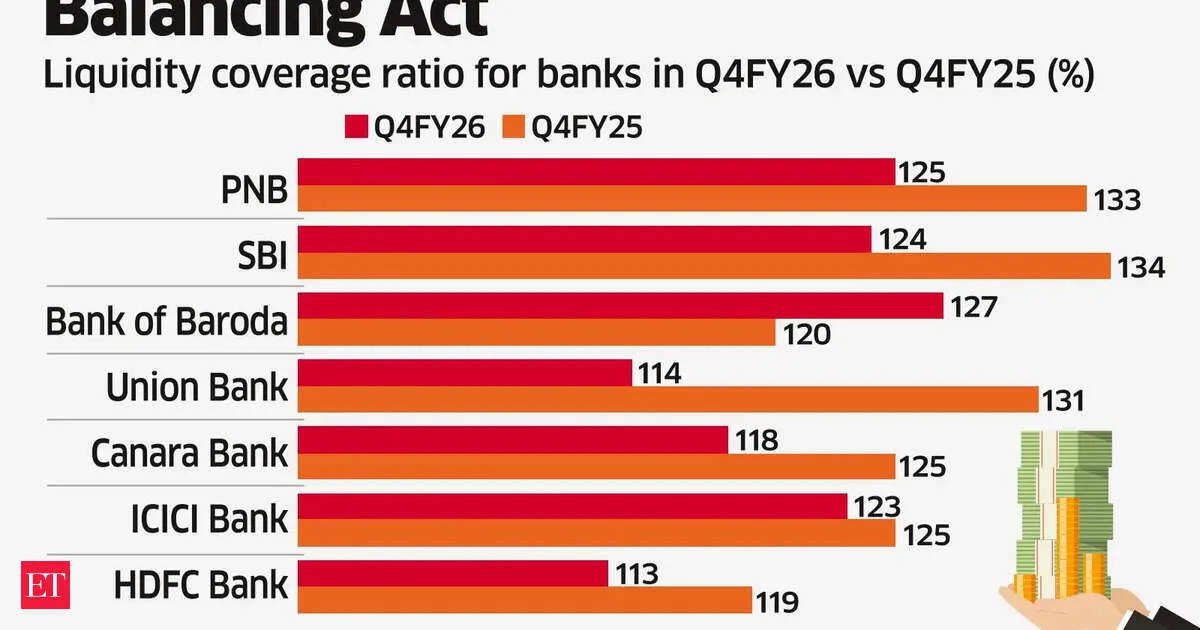
State-run banks in India are edging closer to regulatory minimums as liquidity coverage ratios fall, driven by loan growth outpacing retail deposit growth. In the March quarter, major PSU banks saw LCR drop by 10–12 percentage points to around 114%–118%, nearer the 100% threshold. Union Bank, Canara Bank and SBI reported sharp year-on-year declines while loans grew faster than deposits. Analysts warn the “easy” strategy of funding credit using excess liquidity is running out, though new norms from Q1 FY27 may ease runoff rates.
Public sector banks in India recorded loan write-offs at multi-year lows in FY25-26, driven by fewer new problem loans and stronger recoveries from existing stressed assets. PTI analysis of earnings showed most PSUs had write-offs lowest in up to eight years, including Bank of Baroda and Punjab National Bank. The shift also coincided with improved asset quality, with gross and net NPA ratios falling to 1.93% and 0.39% by March 31, 2026, alongside sharply higher recoveries and record profitability.
Your news, in seconds
Get the Beige app — every story in 60 words, updated hourly. Free on iOS & Android.
SBI’s margin drop set the tone for PSU banks, but analysts believe the downside could be nearing an end. Focus is shifting to private banks, seen as better placed for FY27, with foreign investor flows expected to influence stock moves. HDFC Bank and Axis Bank are highlighted as top picks, while Paytm is favored for its payments business.
Canara Bank’s Q4FY26 consolidated net profit fell 10% year-on-year to Rs 4,506 crore, even as net interest income rose 4% to Rs 9,808 crore. Sequentially, profit dropped 13% from the previous quarter. The market reacted sharply: the PSU lender’s shares slid about 7% after results, hitting an intraday low of Rs 130.50 on NSE.
Indian equity markets have held up despite geopolitical tensions and volatile oil prices, signaling that investors may think the worst is already priced in. Market expert Nischal Maheshwari backs a “buy on dips” approach, pointing to a shift from PSU banks toward private lenders. He also flags auto stocks, saying valuations need caution.
India’s earnings season is pointing to a recovery that is real, but not dramatic. FMCG is getting a rural demand lift, yet growth remains modest. PSU banks have cleaner balance sheets, but net interest margins are under quiet pressure. Power and EMS demand stays strong, though profit durability may hinge on raw material costs and intensifying competition.
Never miss a story
Set alerts for the topics and sources you care about. Download Beige for free.
Indian markets surged for a second straight session as Sensex gained 380 points and Nifty inched toward 24,400. The rally was driven by growing optimism that the Iran US conflict could de escalate sooner than feared, pulling midcap and smallcap stocks higher too. PSU Banks led sectoral gains amid improving risk appetite.
A new committee will assess public sector banks’ capital constraints, as India looks to deepen its corporate bond market to broaden access to finance. The plan targets smoother flow of capital to all borrowers, including small businesses and farmers, at competitive rates. Authorities also want tighter regulation to improve market functioning and trust.
Indian markets tumbled on Thursday as metals and PSU banks dragged sentiment while the rupee came under pressure. Rising oil prices and rumors of possible military action against Iran spooked investors and weighed on risk appetite. The Reserve Bank of India intervened to support the currency, even as April delivered the market’s best performance in 28 months. Trading is shut Friday for Maharashtra Day.
India’s credit card universe has crossed 119 million cards, with HDFC Bank tightening its grip on both card counts and spend value. Major players like SBI Cards, ICICI Bank and Axis Bank remain prominent, but public sector banks are gaining momentum—especially in tier-2 and tier-3 cities—supported by wider acceptance networks and strategic partnerships.
Reading on mobile?
Open Beige in the app for a smoother experience — free on iOS and Android.
RBI’s new Expected Credit Loss framework is set to weigh on profitability repeatedly, not just as a one-off capital shock. PSU banks may take a larger hit because provisioning floor rates remain unchanged, pressuring returns on assets. The outlook varies across private banks, with some cushioned by contingent buffers while others could face sharper effects.
PSU bank stocks slid up to 3% after the RBI confirmed the Expected Credit Loss (ECL) framework rollout from April 2027. Investors fear higher provisioning and capital pressure, with brokerages estimating a potential 5–10% hit to net worth. While the rules arrive gradually, lenders still face near-term uncertainty over balance-sheet impact.
Over the past decade, public sector banks have lost major ground in deposits, with their share dropping from 76.3% to 56.3%. Private banks, by contrast, have steadily absorbed the shift, rising from about 20% to nearly 35%—suggesting a growing preference among depositors, especially wealthier customers.
Swipe through stories, personalise your feed, and save articles for later — all on the app.