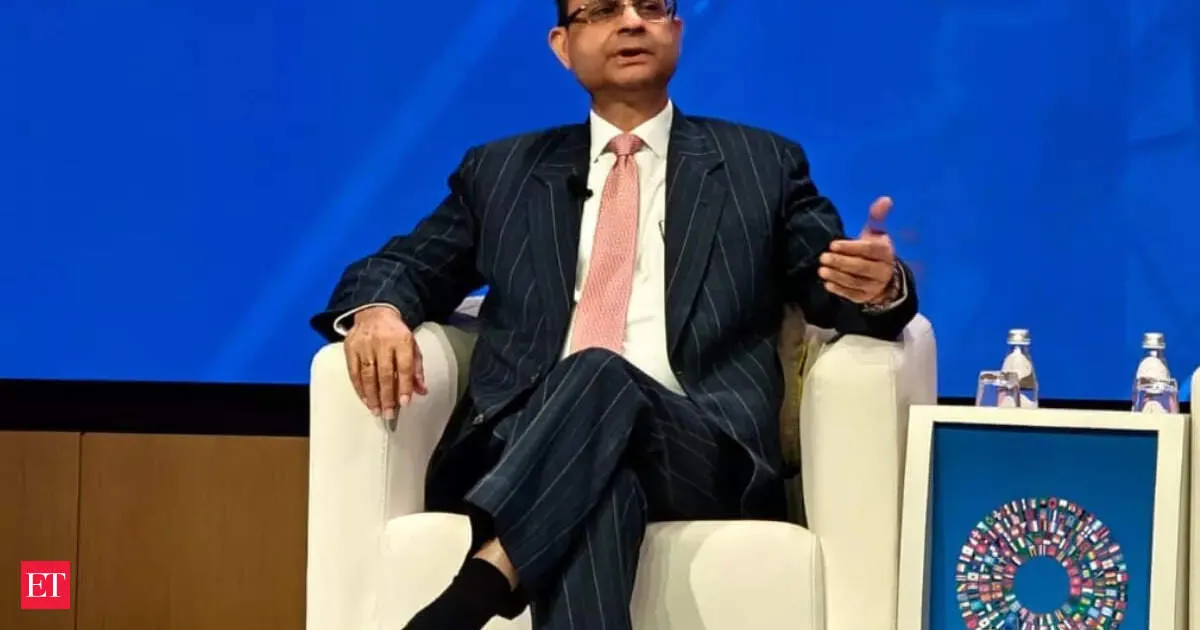
DBS chief economist downplayed concerns about India’s recent foreign direct investment slowdown, arguing it’s not a cause for alarm. With global capital increasingly flowing to Asia’s fast-growing electronics and AI sectors, the dip in India’s inflows appears manageable. The broader world economy, the economist noted, is showing resilience despite geopolitical turbulence.
India’s information and broadcasting sector attracted sharply lower FDI inflows in Q3 of FY26, but the overall picture improved across the first nine months. Cumulative inflows rose meaningfully, supported by sizable investments in major companies such as Prime Focus, alongside multiple smaller deals that added up to the stronger mid-year total despite the late-quarter slowdown.
Your news, in seconds
Get the Beige app — every story in 60 words, updated hourly. Free on iOS & Android.
India’s FDI fast track has been updated with a new SOP covering 40 sub-sectors, including strategic areas like rare earths and PCB-linked activities. The government is also issuing reporting guidelines for investments in India where the investor has direct or indirect ownership connections to citizens or entities from countries sharing a land border with India.
India has announced faster processing of FDI proposals from China and other land-bordering nations by designating 40 manufacturing sub-sectors for clearance within 60 days. The list includes rare earth magnets and electronics, aiming to accelerate domestic production. Despite quicker approvals, Indian citizens must retain majority ownership and control, alongside new reporting guidelines for these investments.
DPIIT has rolled out an updated Standard Operating Procedure for processing Foreign Direct Investment proposals, aiming to make outcomes faster and more predictable. Under the new framework, decisions are expected within 12 weeks, excluding time taken by applicants to respond. The entire workflow is paperless, and investments from border countries are routed to the Ministry of External Affairs.
India has notified 100% foreign direct investment in insurance companies via the automatic route, coming into effect under the Insurance Laws (Amendment) Act, 2025. The move follows Cabinet clearance and raises the FDI cap from 74% to 100%, aiming to boost long-term capital and insurance penetration. Foreign investment still needs IRDAI regulatory clearance, with conditions including resident leadership, RBI FEMA pricing norms, and LIC remains capped at 20%.
Never miss a story
Set alerts for the topics and sources you care about. Download Beige for free.
The Centre has allowed 100% FDI in the insurance sector through the automatic route, a major shift from tighter entry conditions. The move keeps FDI subject to the Insurance Act, 1938, and requires companies receiving foreign investment to obtain the necessary licence or approval from IRDAI to undertake insurance and related activities.
India has relaxed foreign investment rules under FEMA, letting overseas firms with up to a 10% Chinese ownership invest through the automatic route without prior government approval. The immediate change aims to revive foreign capital inflows and comes after restrictions introduced in 2020. The update applies right away for eligible investments, signalling a more open stance.
India has notified 100% FDI in insurance companies under the automatic route, meaning foreign investors can invest fully without prior approvals. The move is aimed at easing entry into the sector, but the LIC investment cap is reported to remain at 20%, preserving a key restriction even as overall foreign participation expands.
India’s Department of Economic Affairs is finalising the FEMA approval needed to notify eased FDI rules for overseas firms holding up to 10% Chinese shareholding. An official said the announcement is expected soon, following a March Press Note by DPIIT that already expanded automatic-route investments from land-border countries across sectors.
Reading on mobile?
Open Beige in the app for a smoother experience — free on iOS and Android.
India is preparing to loosen FDI rules for foreign firms that include Chinese stakeholders up to a 10 percent limit. The move is designed to attract more investment, especially in key manufacturing sectors, while speeding up the approval process for eligible proposals. The policy shift signals a more business-friendly approach as India seeks investment momentum.
Andhra Pradesh Chief Minister N Chandrababu Naidu urged corporates to invest and share feedback on state reforms, pointing to tools like escrow accounts and subsidized land for IT firms. He says these measures have already drawn large investments, including Google’s reported $15 billion FDI, and are now supporting welfare initiatives across the state.
Andhra Pradesh’s Amaravati is set to be developed as the “world’s quantum valley,” with a focus on AI and data centres to attract major FDI. Chief Minister Chandrababu Naidu outlined a digital, knowledge-led ecosystem built around a “4P” partnership model, while the state’s clean energy strength is expected to boost large investments in data infrastructure.
India’s gross FDI inflows rose 13% to $90.8 billion in January 2026, but net FDI remains near all-time lows. Morgan Stanley points to surging profit repatriations and increased outward investment as key drivers, leaving net inflows around $0.5 billion even as gross equity flows hit a three-year high.
Follow your favourite sources
Track sources, tags and categories — all in the Beige app.
RBI Governor Sanjay Malhotra told financial leaders in New York that the central bank is closely monitoring short-term economic fluctuations, including FDI outflows. He outlined reforms to strengthen foreign investment and deepen market integration, while pointing to India’s low inflation and strong foreign exchange reserves as proof of resilient fundamentals.
South Korean President Lee Jae Myung’s New Delhi visit highlights India’s push to pull in large-scale foreign direct investment in advanced manufacturing and technology. Talks centered on deepening capital flows for priority sectors like semiconductors, shipbuilding, and energy, as both sides look to ride global supply-chain shifts and position India as a top investment destination.
India’s thriving IPO market is helping global investors lock in major exits, but it’s also squeezing the rupee. As PE and VC funds repatriate returns, net FDI has fallen sharply, increasing vulnerability to shifting capital flows. Analysts say the current churn looks like stress, yet it could also be the beginning of a more mature, stable capital cycle by FY27.
Refurbished electronics firm Grest has secured strategic early-stage FDI from Japan’s ICMG, marking a notable cross-border vote of confidence for India’s recommerce market. The move lands as global investors and consumers increasingly look to refurbished devices, with industry forecasts pointing to strong growth for used smartphones.
Stay informed on the go
Bite-sized news from 100+ trusted sources, right in your pocket.
RBI data shows select FDI companies in India saw net sales growth moderate to 8.7% in FY25, down from 9.4% in the prior year. Services sales rose slightly, but manufacturing growth decelerated. Operating profit growth also slipped to 10.7% as companies absorbed higher expenses, signaling pressure on margins despite steadier demand.
India has eased parts of its foreign direct investment framework, allowing companies to offer ESOP stock options to employees in China, Nepal, and Hong Kong. At the same time, NRIs and expats located in these regions can invest directly in Indian stocks. The adjustment to rule PN-3 is designed to make hiring and talent management easier, especially for firms with overseas teams.
Swipe through stories, personalise your feed, and save articles for later — all on the app.