Researchers from UIUC and Stanford propose RecursiveMAS, a multi-agent framework that replaces text-to-text communication with latent embedding passing. Instead of generating reasoning tokens at every step, agents loop continuous representations through RecursiveLink modules and only output text at the end. Tests across nine benchmarks show up to 2.4x faster inference, 75% token reduction by round three, and an 8.3% accuracy gain, with far cheaper training than full fine-tuning.
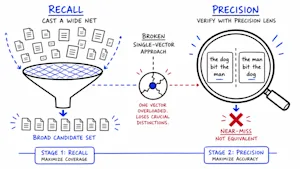
Redis research warns that fine-tuning RAG embedding models for “compositional sensitivity” can quietly harm general retrieval, dropping accuracy up to 40% on production mid-size models. The issue: structural meaning shifts like negation and role reversals can end up near-identical in embedding space, while common fine-tuning metrics miss it. Agentic pipelines are especially vulnerable.
Your news, in seconds
Get the Beige app — every story in 60 words, updated hourly. Free on iOS & Android.
Swipe through stories, personalise your feed, and save articles for later — all on the app.