New VB Pulse data suggests the enterprise fight is shifting from model quality to the “control plane” where AI agents plan, call tools, access data, and get audited. Microsoft Copilot Studio and Azure AI Studio lead adoption, OpenAI follows, and Anthropic’s Claude registers a first measurable foothold at orchestration—hinting model momentum may be spilling into runtime infrastructure.
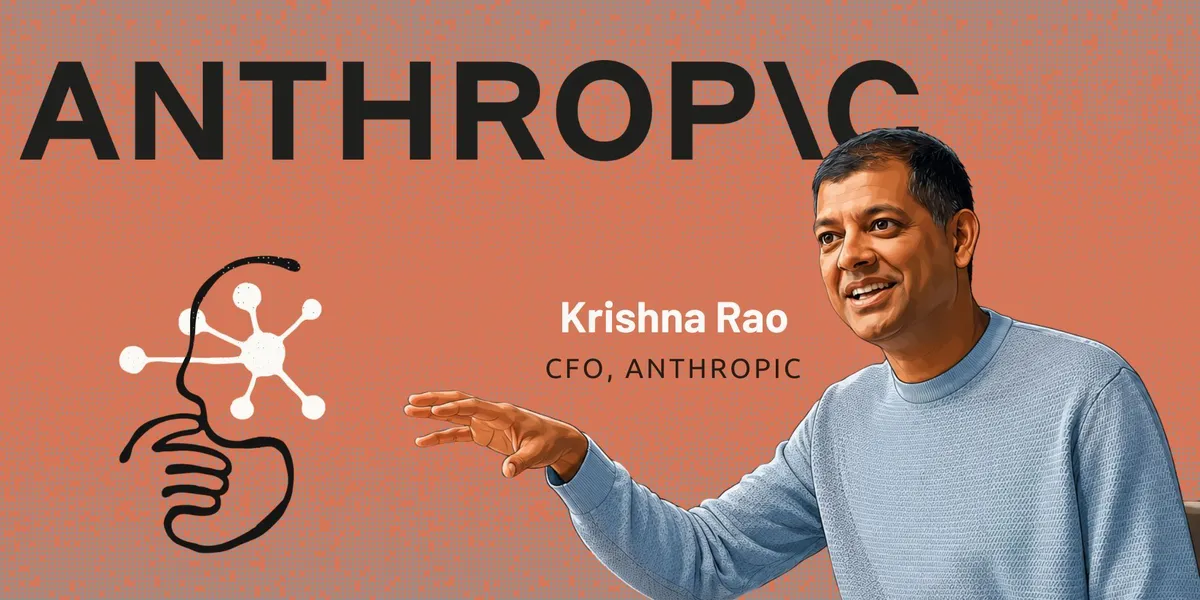
Anthropic’s CFO Krishna Rao says more than 90% of the company’s internal code is generated by its agentic AI tool, Claude Code. He adds that the company uses dozens of specialized AI workflows to automate finance and enterprise operations, shrinking tasks that used to take hours—like revenue and compute utilization reporting—into roughly 30 minutes. Even then, AI typically produces 90–95% of outputs before human review, allowing employees to focus on judgment, strategy, and oversight while hiring accelerates.
Your news, in seconds
Get the Beige app — every story in 60 words, updated hourly. Free on iOS & Android.
In a first podcast appearance, Anthropic CFO Krishna Rao lays out how the AI lab scaled from about $250M in run-rate revenue two years ago to roughly $30B by early 2026—driven by a ruthless “compute” strategy. He describes long-horizon planning, multi-vendor chip bets across Trainium, TPUs, and GPUs, and why interpretability and safety research is now boosting enterprise trust and retention.
Anthropic is reportedly close to agreeing terms for a $30 billion fundraising round that would value the AI company at $900 billion, according to the Financial Times. The deal could close as soon as this month, though details may shift. Investors including Dragoneer, Greenoaks, Sequoia Capital, and Altimeter Capital are expected to co-lead, with $2 billion-plus commitments each. The valuation would be nearly triple its prior $350 billion mark. Annualised revenue is projected to top $45 billion. Meanwhile, its infrastructure partnerships with SpaceX, Google, Broadcom, and AWS are set to drive rising compute costs.
A US federal judge has delayed final approval of Anthropic’s proposed $1.5 billion settlement with authors over alleged book piracy used to train its Claude AI. At a hearing in San Francisco, Judge Araceli Martinez-Olguin asked lawyers for more details, particularly around attorney fees and payments to lead plaintiffs, calling the deal the largest known US copyright settlement. Earlier, now-retired Judge William Alsup found fair use but said Anthropic violated rights by storing over 7 million pirated books.
Anthropic and the Bill & Melinda Gates Foundation are launching a $200 million, four-year partnership aimed at AI “public goods” in health and education. Anthropic will contribute technical staff and Claude AI usage credits, while Gates Foundation funding includes grants, program design and expertise. The effort targets major gaps in AI performance for African languages through improved data collection and labeling shared publicly. It also plans teacher-oriented knowledge graphs, plus projects using Claude to help predict drug candidates for HPV and preeclampsia.
Never miss a story
Set alerts for the topics and sources you care about. Download Beige for free.
Anthropic’s Claude Code product head Cat Wu argues the next phase of AI won’t just respond to prompts—it will act proactively. These systems can understand workflows, anticipate needs, and automate repetitive tasks, reshaping software development and productivity. But Wu stresses that human oversight and decision-making remain essential as AI becomes more autonomous.
Anthropic is reversing its earlier ban on using Claude subscriptions for third party agent tools like OpenClaw. Subscribers can again allocate new “Agent SDK” credits to programmatic workflows, but the credits are limited, non rollover, and billed like API usage after they run out. The move aims to stop costly token overruns that strained compute and pricing.
New figures show Anthropic has pulled ahead of OpenAI in enterprise AI spending, with 34.4% of surveyed companies paying for Anthropic products in April. The jump is attributed mainly to growing demand for Claude Code, Anthropic’s AI coding assistant. The result suggests a faster, tool-driven shift in how businesses are choosing their next AI vendor.
For the first time, more U.S. businesses are paying for Anthropic’s Claude than for OpenAI’s ChatGPT, according to Ramp’s AI Index. Adoption jumped to 34.4% for Anthropic while OpenAI slipped to 32.3%. Yet Ramp flags three threats: runaway token costs, compute and reliability strain, and cheaper competition from open source and Codex.
Reading on mobile?
Open Beige in the app for a smoother experience — free on iOS and Android.
With Anthropic’s Mythos AI still hard to access, organizations are turning to Claude Opus 4.7 for cybersecurity work. Firms use it to hunt threats and respond to incidents, citing that Opus 4.7 can deliver roughly 70–80% of Mythos’ capability—enough to tackle vulnerabilities while waiting for wider Mythos availability.
Anthropic’s latest move signals a shift in AI competition: the customer hunt is moving downmarket from Fortune 500 giants to America’s vast base of small businesses. With 36 million small firms powering the economy, the new offering suggests user acquisition and product adoption will increasingly hinge on meeting day-to-day needs outside big enterprise budgets.
Anthropic has reached a milestone: for the first time, it has more verified business customers than OpenAI, according to Ramp’s latest AI Index. The fintech data suggests enterprise adoption may be shifting faster toward Anthropic than OpenAI, offering a new signal of momentum in the competitive race for corporate AI usage.
AI firm Anthropic is reportedly in advanced talks to acquire Stainless for more than $300 million. Stainless builds software that helps users access AI models more easily. The move comes as Anthropic also explores raising at least $30 billion in new funding, with its valuation potentially topping $900 billion.
Follow your favourite sources
Track sources, tags and categories — all in the Beige app.
Anthropic says eight secondary marketplaces are selling its shares without authorization, warning investors that those buys won’t be recognized because the company doesn’t allow transfers through those channels. The firm has previously warned about fraudulent share certificates and now specifically cites platforms such as Hiive and Forge Global as violating its transfer restrictions.
Anthropic says it has identified eight firms trading its shares without authorization and warns investors that those purchases may not be valid. The issue highlights how secondary markets let early investors and employees sell stakes in private companies—an increasingly common practice as more firms remain private longer.
Anthropic has rolled out new Claude AI tools built for lawyers, adding specialized legal topic support and ways to access other legal research and AI products. The update lets law firms securely connect Claude with platforms like Thomson Reuters for research and document management, aiming to streamline legal workflows while keeping sensitive materials integrated through approved channels.
The AI legal services space is accelerating as Anthropic moves beyond general-purpose chat into tools built for law firms. The company is rolling out a suite of features aimed at helping legal teams with work that typically takes time, such as research, drafting support, and case preparation workflows. The launch signals intensifying competition among AI vendors targeting legal practice.
Stay informed on the go
Bite-sized news from 100+ trusted sources, right in your pocket.
Anthropic has warned investors that several secondary platforms are not authorized to help buy or sell its shares. In a notice naming companies including Open Doors Partners and Forge Global, the firm said these platforms should not be considered legitimate access points for its equity. The move adds fresh caution for anyone using share-trading intermediaries outside official channels.
US top banks are scrambling to patch IT vulnerabilities flagged by Anthropic’s Mythos AI tool. The system reportedly finds a broad set of security gaps, prompting urgent repairs and software upgrades. Anthropic’s findings are also being shared with smaller banks, speeding the cycle of fixes—though the rapid changes could temporarily disrupt customer services.
Swipe through stories, personalise your feed, and save articles for later — all on the app.